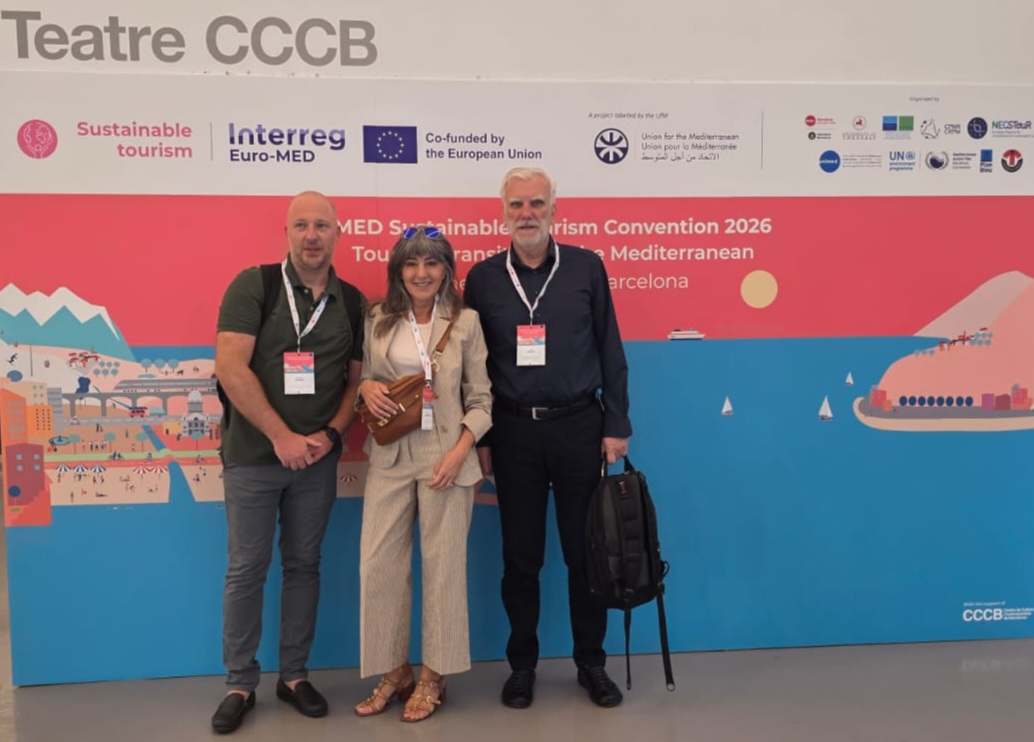

Representatives of PI RERA, a partner in the TOURISMO project implemented under the Interreg Euro-MED Programme, participated on 18–19 June 2026 in the III MED Sustainable Tourism Convention held in Barcelona. The event brought together around 250 participants from 18 Mediterranean and European countries, including representatives of public institutions, development agencies, research organisations and European projects focused on sustainable tourism development.
This year’s Convention, titled “Tourism Transition in the Mediterranean”, was dedicated to the challenges and opportunities shaping the future of tourism in the Mediterranean. Discussions focused on climate change adaptation, protection of natural resources, digitalisation of tourism destinations, circular economy approaches, and the development of more resilient and sustainable tourism models.
One of the central topics was the role of data and digital technologies in destination management. Participants highlighted that growing visitor numbers, strong seasonality, and increasing pressure on natural and cultural heritage require new approaches to tourism planning and governance. In this context, data-driven decision-making was identified as a key prerequisite for sustainable destination development.
The TOURISMO project was presented during a thematic session dedicated to smart tourism destination management by Enrico Collini, Research fellow at the Department of Information Engineering (DINFO) at the University of Florence and a member of the DISIT Lab, one of the project’s technical partners. Mr. Collini talked about how TOURISMO develops innovative tools for real-time monitoring of tourist flows using sensors, data analytics, and digital technologies, enabling a better understanding of visitor movements, timely responses to tourism pressures, and more efficient destination management.
Alongside TOURISMO, other good practice examples from the Interreg Euro-MED Programme were presented. The LIBECCIO project is developing a digital platform that integrates data from multiple sources and enables forecasting of tourism trends, while MedDiet Go promotes sustainable rural development through cooperation between local communities, entrepreneurs, and institutions, based on the values of the Mediterranean diet. The SMITour project focuses on valorising industrial heritage through innovative tourism products and digital solutions that contribute to seasonality reduction and diversification of the tourism offer.
Discussions during the Convention confirmed that digital transformation in tourism is not purely a technological issue. Equally important are public–private cooperation, skills development, and the establishment of effective governance models that enable the use of data for better decision-making. The experiences presented in Barcelona demonstrated that technology delivers the greatest value when used as a tool to create more sustainable, resilient, and high-quality tourism destinations.
Participation in the III MED Sustainable Tourism Convention provided RERA representatives with an opportunity to exchange experiences with partners from across the Mediterranean, gain insights into the latest trends in sustainable tourism, and strengthen international cooperation within the TOURISMO project and other initiatives supporting the green and digital transition of the tourism sector.