
The Mediterranean is famous for its idyllic coastlines and historic cities, but behind the postcard-perfect views, many of these popular destinations are struggling. Rapid urbanization, the escalating impacts of climate change, and the sheer volume of tourists are putting unprecedented pressure on local infrastructure and the environment. Traditional approaches to managing these crowds are simply no longer enough to preserve the cultural and environmental integrity of these locations.
To address these challenges, an Interreg Euro-MED funded project called TOURISMO turned to cutting-edge technology to understand and rethink how visitors or vehicles move through Europe’s most popular hotspots. TOURISMO’s mission is to advance a tourism model that combines traffic counting technologies with sustainable tourism planning. Consequently, TOURISMO successfully implemented a vast array of innovative counting technologies across eight Mediterranean pilot sites with high tourism pressure. The pilots utilised visual sensors, Internet of Things (IoT) devices, and edge artificial intelligence (AI) to monitor visitor inflows and behavioural patterns in real-world applications as diverse as the destinations themselves:
- In Florence, Italy, researchers are utilising thermal cameras paired with AI to improve the efficiency and management of tourism flows.
- In Varna, Bulgaria, drones are taking to the skies to monitor tourist movements.
- In Malta, advanced visitor counting technology is being used on busy beaches to balance protected area opportunities with environmental monitoring.
- In Valencia, Spain, crowd monitoring is tracking the flow of people moving from the bustling cruise port directly into the historic city centre.
The integration of data from various sensors was integrated into an advanced data analytics platform (SNAP4CITY), enabling destinations to generate visualisations and inferences that enable leaders to make predictive data-driven decisions to manage visitor flows which are linked to actionable sustainability indicators. Rather than just counting people, the project uses these tools to monitor optimal saturation levels at heritage sites, track pedestrian traffic, and even measure environmental conditions like air quality and noise. The focus is on finding a balance: ensuring a positive visitor experience while protecting the quality of life for local residents.
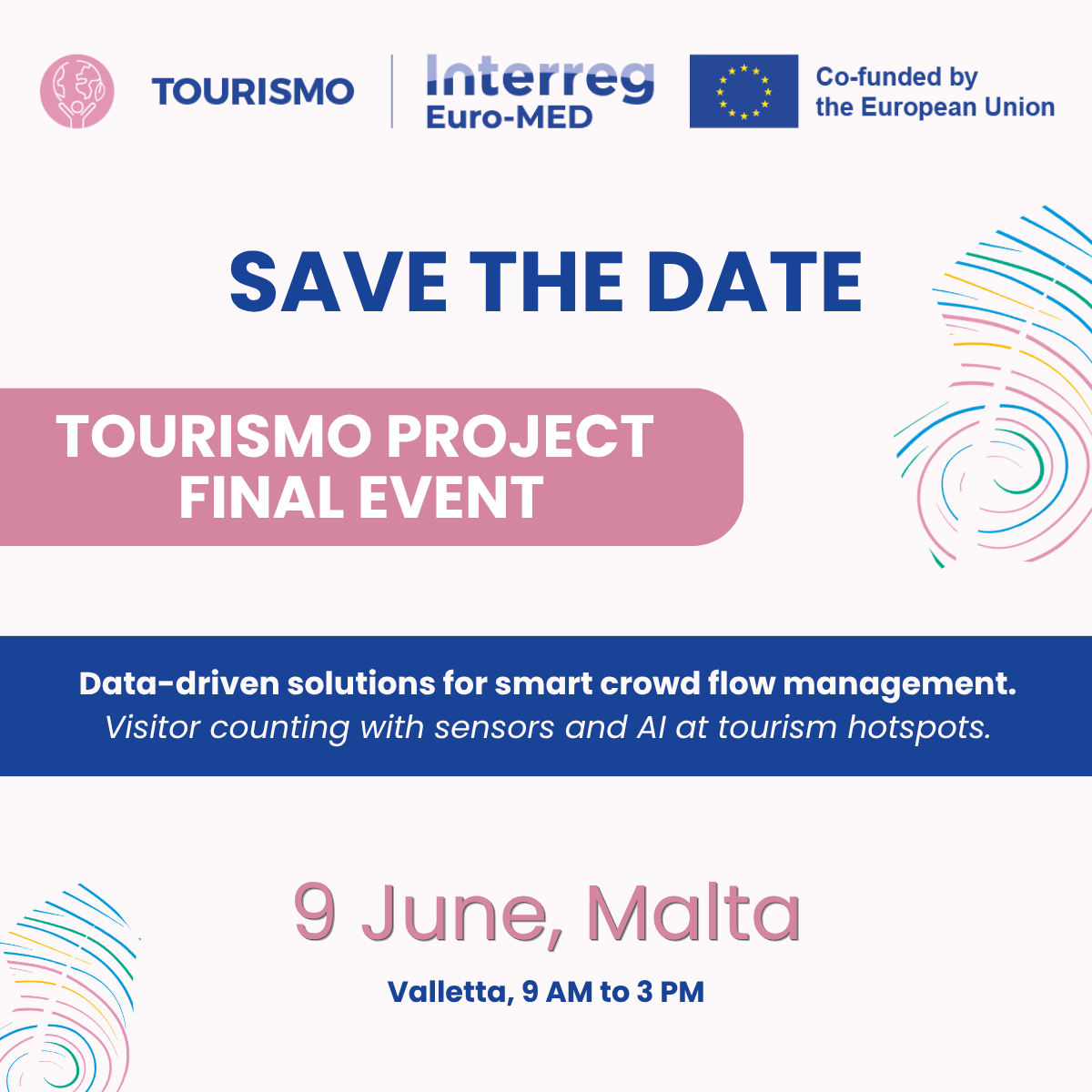
The culmination of this ambitious initiative will take place at the TOURISMO Final Conference dedicated to exploring data-driven solutions for smart crowd flow management at these Mediterranean tourism hotspots. The event will take place on June 9, 2026, from 9:00 AM to 3:00 PM at the Valletta Design Cluster (Il-Biċċerija l-Antika) in Valletta, Malta; with lunch included. We are inviting experts, city leaders, transport authorities, and technology partners to dive into key discussion points and best practices like the growing role of computer vision in environmental monitoring, the challenges of scaling AI sensor technologies within urban or coastal tourism hotspots; or how data-driven solutions can create smarter, more sustainable cities. A copy of the final agenda can be found here.
Attendance is free but spaces are strictly limited to 60 people. Those interested in accelerating their smart tourism strategies can register online or via email to info@mrddf.org.
Location: Il-Biċċerija l-Antika, Valletta Design Cluster, 25 Bull Street, Il-Belt Valletta, Malta.